It is often theorized that the Cushitic groups originated from the horn of Africa, the Nilotic groups from Sudan and the Bantu groups from West Africa. This is largely plausible, but might not always be true. Going by the traditions of local people, the migratory patterns are actually much different from what history asserts.
This piece seeks to look at the history of the Northeast Bantu group specifically, but also to a lesser extent, central Kenya Nilotic groups and Northern Tanzania groups. In essence, it covers groups like Mijikenda, Kamba, Kikuyu, Meru and Embu groups plus Maasai and Samburu. We will analyze the historical accounts according to the people themselves and try to piece together the information with recorded history from other parts of the world about the history of the area.
What was Azania?
Azania is a small historical civilization that is mentioned adversely by various travelers. This civilization expanded over time and it is specifically given its name by Greek travelers, particularly Ptolemy. From the accounts of the historical travelers, the location of Azania is stated as the current area that spans from the southern coast of Somalia, the coast of Kenya and perhaps as far south as the coast of Tanzania. This place was visited by various travelers from ancient Europe, Arabia, India and even China. It was part of a vibrant African civilization that was thriving during the 500 BC to around 500 AD era.
The Shungwaya, Mbwaa and Other Myths of Origin
One of the most famous pre-colonial myths of origin of the Mijikenda people states that they came from a place known to them as Shungwaya. This exact location is said to be somewhere between the northern coast of Kenya and southern coast of Somalia. The elders responsible for keeping the tradition and history, stated that the migration south was caused by the invasion of Cushitic groups. The migration of the Mijikenda is said to have occurred in the 17th century.
Earlier on though, it seems that other groups of the Northeastern Bantu group might also have migrated from the same area for different reasons. According to Meru history, the people of the Mt Kenya region migrated from a mythical place identified as Mbwaa. This place is also said to be along the coast of East Africa. The oral history states that the occupations of the people in the area were fishing, farming and trading. The migration of the Mt Kenya peoples is said to have commenced around the 12th century. The migrants followed the course of the river Tana, north to the central highlands of Kenya.
The Mbwaa or Shungwaya area is thus deemed by many researchers to be an early settlement of the Northeastern Bantu. Due to invasions by foreign powers though, the early settlers were forced to migrate further inland.

- Ancient Azania and Migration Routes
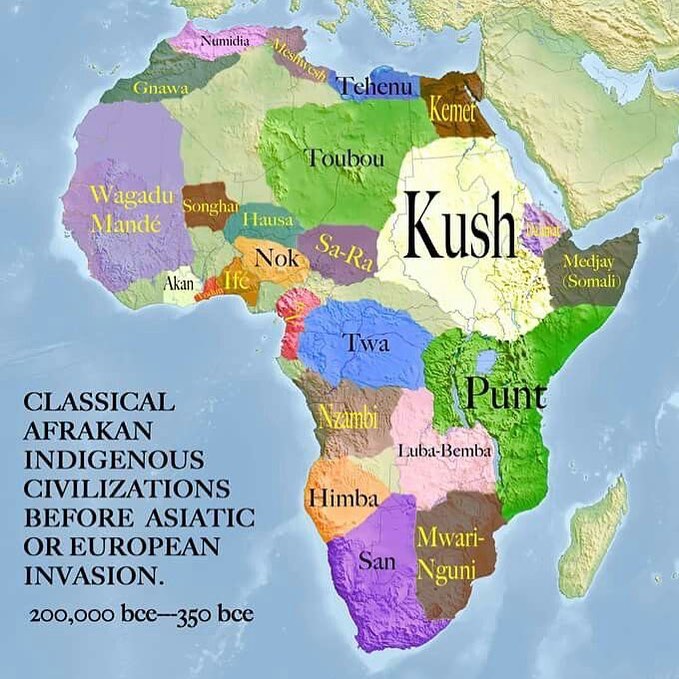
It is important to note that historians maintain that groups like the Kamba migrated from the South, while groups like the Meru maintain that they migrated from the North. A quick look at the above map shows that both these two assertions are true considering that Azania covered a big stretch of both the north and southern coasts of East Africa.
Historical records by Greeks and Romans mention the existence of ironworking, trading and farming cultures in established small civilizations along the coast of East Africa. Two of the names mentioned in the 1st century of the common era are Azania and Rhapta. Rhapta was the southernmost town of Azania. Azania itself was much bigger and hosted communities of farmers, herders and traders. Considering the historical accounts of migrations of the Northeastern Bantu people, it is clear that they were the occupants of Azania before their migrations. Research in cultural, archeological, genetic and linguistic evidence has also pointed to the same fact. Let us analyze each strand of evidence.
Cultural evidence
In terms of culture, the Northeastern Bantu are known to have introduced ironworking, farming techniques, livestock keeping and trading to the interior. Indeed, historical records show that groups like the Kamba were the most established long-distance traders up until the 19th century, when the Swahili took over the trade especially at the coast. The Kamba traded goods like ivory, various metals and animals like giraffes & tortoises or their products.
The Kamba were the link between the Meru & Kikuyu to the coast. The three groups nevertheless were all involved in the same activities of trade, farming, and ironworking; even though the Kamba dominated in trade while the Kikuyu and Meru heavily relied on agriculture. Extensive research has been done on the Akamba trading expertise, their trading routes and trading commodities among other things.
Linguistic evidence
The Swahili civilizations are known to be among the oldest Bantu civilizations in the coast of East Africa. The only known precursor to the Swahili city-states is Azania. Early Bantu settlers are said to have been in the coast of East Africa by the 1st century CE. At this time, the Swahili civilizations were at the formative stages and no foreign influence had occurred on the culture yet. It is thus expected that the Swahili were either part of the Azanian civilization, or at least, were in contact with Azanians.
History states that the original name of the Swahili language was Ngozi (Kingozi), while the oldest dialect of the Mt Kenya peoples is Ngaa (Kingaa), which is a precursor to the language that is now known as Meru. If the Swahili were in contact with Azanians at a particular point in history, then the languages of both the Swahili and Azanians would have to share critical linguistic features. Indeed, simple linguistic evidence indicates that the oldest forms of the Swahili language are close or identical to languages like Meru, Kamba and Kikuyu.
Old Swahili words like chanda (finger), kenda (nine), mbari (clan), mwali (girl), urongo (lie), and hundreds of others, are still used in the Northeast Bantu languages. Apart from that, the noun/gender classes present in Kiswahili are also present in the Northeast Bantu languages. The structure and formation of sentences are also very similar between the languages. Unfortunately, sufficient research has not been published on the similarities of the different languages in Kenya, but the general linguistic facts are known to speakers of either coastal or highland bantu languages.
In contrast to assertions made by historians particularly in the 19th and even 20th century, the Swahili language is not a syncretic language, whether in structure or origin. Instead, it is a fully autonomous language. The language is classified as a Bantu language, and its lexical and semantic aspects attest to this fact. An analysis of languages like Kikuyu, Kamba and Kimeru among others also shows the critical history and evolution of Swahili as well as the Northeast Bantu languages.
The possible remnants of the ancient Azanian language cluster are still present in the coastal area currently as Afro-Arab Bantu groups like Swahili, Bajuni and Barawa. While the languages of these groups have clear recent influences from Arabic and other languages, they are still very similar to the Northeast Bantu languages of the interior.
Genetic traits
Like their Maasai, Samburu and other Nilotic neighbors in the highlands, the Northeast Bantu do not have typical genetic traits that characterize the entire group. Instead, their genetic profile is an outlier – being neither Nilotic nor Bantu. Indeed, the Maasai, Meru, Kikuyu, Samburu and Kamba are all groups that do not particularly fit into their Nilotic or Bantu clusters in genetic terms. These groups have inherited genes from Nilotes, Cushites, Bantu and other groups; thus giving the genetic profile of a typical person a high level of admixture. Regardless of that, there are established genetic markers that identify all these groups as part of the same genetic heritage. Like the linguistic evidence though, the genetic studies are also still in the early stages and more publications of research will provide full clarity of the facts.
Archeological evidence
There are many archeological sites that have been discovered in the general area between the coast of East Africa and the rift valley which shows the existence and movements of the Azanians. One of the most known archeological finds came in the form of pottery discovered in Manda, Lamu in the 1990s. Pot remains, which were dated to be about 2,000 years old, gave evidence of the existence of the Northeastern Bantu groups at the coastal region. The round-bottom pots discovered were markedly similar to those made by the Kamba, Kikuyu and Meru in a way that was dissimilar to those made by medieval Lamu inhabitants.
Final thoughts
As with any other kind of historical work, there are always many loopholes and potentially contradictory assertions made by historians. Reconstructing old history from oral accounts is also quite an unreliable method of obtaining historical facts. Going by the various strands of evidence though, there is a strong reason to believe that the historical Azanians are indeed the present-day Kikuyu, Kamba, and Meru peoples as well as the Nilotic peoples of north-central Kenya plus certain Northern Tanzania groups. It is important to note that culturally, there is little difference between the Nilotic and Bantu inhabitants of central Kenya even though the linguistic differences are clear. The aspects of language shift and assimilation of cultures are also a well-recorded facts regarding the people of this area. Western researchers tend to opine that the Azanians were South Cushitic groups. But as the history of southern Kenya and northern Tanzania shows, this might be true in terms of genetics and culture but not necessarily in terms of language.

 Ancient Azania